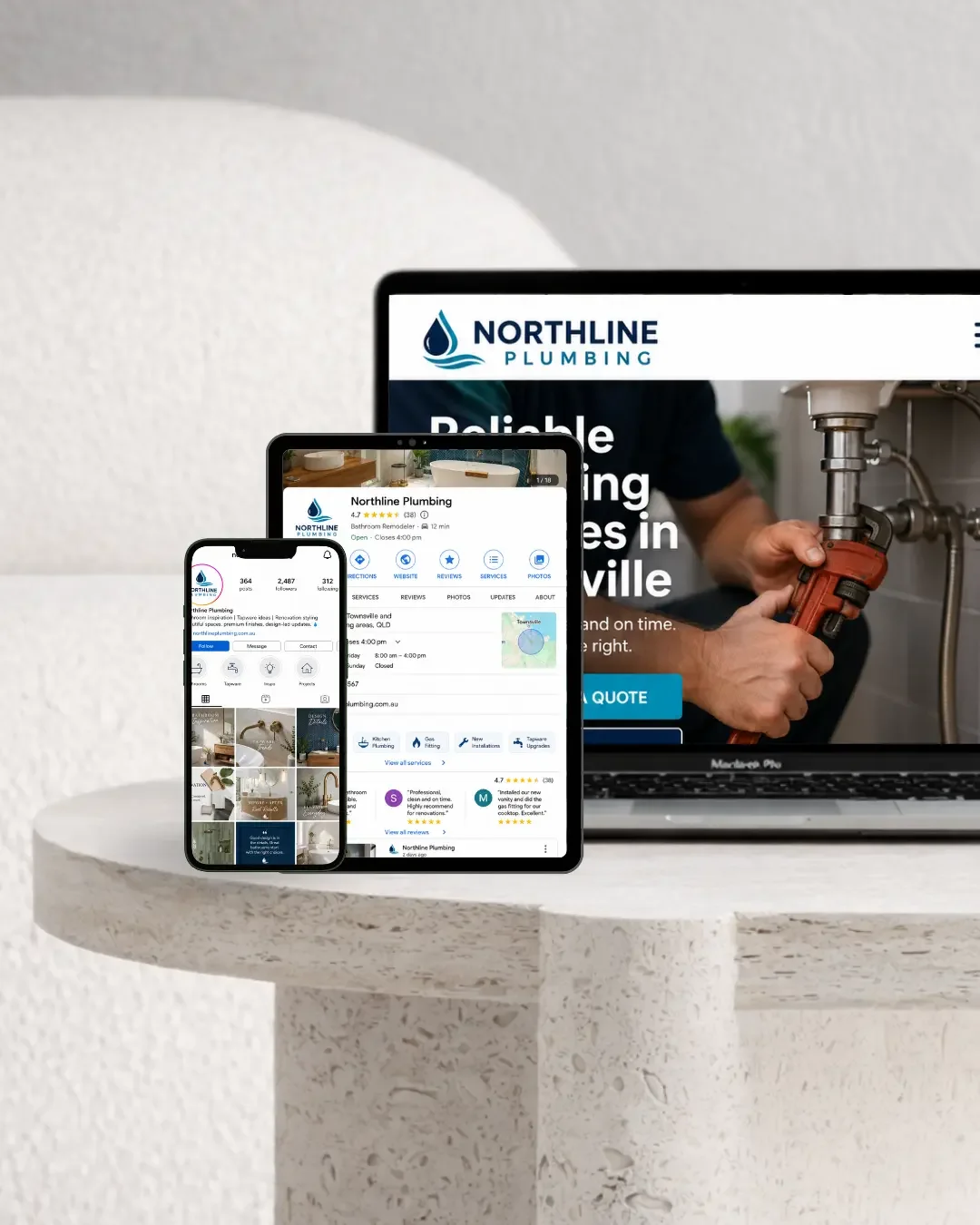
Are your website, google and social media sending mixed messages?
Most business owners look at their website, Google Business Profile and social media as separate parts of their online presence.
The website gets updated when the business changes.
Google gets checked when someone notices the opening hours are wrong.
Social media gets posted to when there is time.
Each platform may look fine on its own. The problem starts when a potential customer moves between them and sees three different versions of the same business.
Your website may promote one group of services.
Your Google listing may still contain old information.
Your social media may be focused on work you no longer want more of.
When those platforms do not line up, customers are left trying to work out which information is accurate. Most people will not spend long investigating. They will usually choose the business that makes things clearer.
Customers rarely make decisions in one place
A customer may first come across your business through social media. They may then search your business name on Google to check your reviews, location and contact details. From there, they may visit your website to look at your services, previous work, pricing or enquiry options. That means their decision is being shaped across several platforms.
They are not only asking:
Does this business offer what I need?
They are also asking:
Does this business look legitimate?
Is the information current?
Do the services match what I saw elsewhere?
Does this feel like the same business?
Can I trust what I am seeing?
Is it easy to work out what to do next?
When every platform reinforces the same message, the customer becomes more confident. When the information changes from one place to another, uncertainty begins to grow.
What mixed messages can look like
Online inconsistency is not always dramatic. Often, it appears in small details that have built up over time. For example, a Townsville builder may have a website focused on new homes, while their Google Business Profile promotes renovations and their social media is mostly filled with small repair work.
A clinic may have updated its services on the website but still have old treatments listed on Google
A plumbing business may describe itself as an emergency plumber on one platform and a bathroom renovation specialist on another.
A professional service business may have one phone number on its website and another on its social media profiles.
Each individual issue may seem minor. Together, they can make the business look disorganised, outdated or unclear.
Common inconsistencies include:
different service lists across platforms
old phone numbers or email addresses
inconsistent opening hours
outdated service areas
different business descriptions
old logos, branding or photography
social media promoting services the business no longer prioritises
a website that no longer reflects the current direction of the business
Google categories that do not match the core service
different calls to action on each platform
broken or outdated links
The customer may not consciously identify every inconsistency. They simply feel less certain. That feeling can be enough for them to keep looking.
Clarity is a trust signal
People often think trust is built only through reviews, testimonials and professional branding. Those things matter, but clarity also plays a major role. A business that presents the same information consistently feels more reliable.
The customer can quickly understand:
what the business does
who it helps
where it works
what makes it different
how to make contact
They do not need to search through several platforms to piece the information together. That makes the business feel easier to deal with. For local service businesses, this matters enormously. Townsville and North Queensland customers generally want straightforward answers. They want to know whether you provide the service, whether you work in their area and whether they can trust you to do the job properly. They are not looking to solve a puzzle.
Your platforms do not need to look identical
Consistency does not mean copying and pasting the same content everywhere. Your website, Google Business Profile and social media each have different jobs.
Your website
Your website should provide the strongest overall explanation of your business.
It should clearly communicate:
your main services
the customers you help
your location or service area
why someone should choose you
proof of your work or experience
the next step to enquire
Your Google Business Profile
Your Google listing should help local customers find and assess you quickly.
It should support buying decisions through:
accurate business details
appropriate categories
clear services
strong photos
recent reviews
helpful updates
a working website link
correct opening hours
accurate location or service-area information
Your social media
Social media should support recognition, trust and familiarity.
It can show:
recent work
behind-the-scenes activity
business personality
helpful advice
client outcomes
proof that the business is active
The platforms can serve different purposes while still telling the same overall story. The customer should never feel like they have found three separate businesses.
Why businesses become disconnected online
Most online inconsistency is not intentional. It happens gradually. A business grows, changes direction or adds new services, but only one platform gets updated.
Someone creates a Google listing years ago and rarely checks it again.
The website is rebuilt, but old social media bios remain unchanged.
A service is discontinued, but it is still appearing in search results.
A new phone number is introduced, but it is not updated everywhere.
Different people manage different platforms without a shared plan. This is common in busy businesses where the owner is focused on serving customers and completing the actual work. The problem is that customers see the full picture, even when the business owner does not.
A disconnected online setup can cost enquiries
A customer does not need a major reason to choose another business. Sometimes, they simply feel more confident elsewhere.
When one competitor has:
clearer services
consistent information
better reviews
stronger photos
an easier enquiry process
one clear message across every platform
they often become the safer choice. That does not necessarily mean they provide a better service. It means they have made the decision easier. This is why more marketing is not always the answer. Sending more people toward a disconnected online setup may only expose the problem to a larger audience. Before spending more money on advertising, content or social media, it is worth checking whether the existing customer journey is clear and trustworthy.
How to check whether your online setup matches
Start by looking at your business as though you were a new customer. Do not rely on what you know about the business. Search for it online and compare each platform.
Check your core message
Can someone quickly understand what your business does from your:
website homepage
Google Business Profile
Facebook page
Instagram bio
The wording does not need to be identical, but the meaning should match.
Compare your services
Make sure your priority services are accurately represented everywhere.
Ask:
Are old services still listed?
Are important services missing?
Is one platform attracting the wrong type of enquiry?
Does the website reflect what the business wants to grow?
Review your business details
Check:
phone number
email address
website link
opening hours
service area
business address
booking links
Small differences can create unnecessary friction.
Compare the overall impression
Look at the business visually.
Do the platforms feel current?
Do the logos, images and business descriptions belong to the same brand?
Does one platform look professional while another looks abandoned?
Check the next step
A customer should always know what to do next.
That might be:
request a quote
book an appointment
call the business
submit an enquiry
send a message
If every platform sends them in a different direction, the customer journey becomes harder than it needs to be.
Signs your online setup needs attention
Your online presence may need to be reviewed if:
customers regularly ask whether you provide a service that is already listed
you receive enquiries for work you no longer want
your Google details are different from your website
your website no longer reflects the current business
social media is active but enquiries remain low
you are visible online but people are not making contact
customers are landing on the wrong page or using outdated contact details
your platforms look unrelated
you are unsure what information is currently showing online
These are not always marketing problems. They are often setup, positioning, trust or conversion problems.
What an Online Setup Review examinex
An Online Setup Review looks at the business from the customer’s perspective. Rather than assessing each platform in isolation, it examines how they work together.
This may include:
website clarity and structure
service messaging
trust signals
enquiry pathways
Google Business Profile accuracy
local visibility
social media positioning
inconsistent business information
outdated content
customer journey gaps
areas where opportunities may be getting lost
The purpose is not to recommend more activity automatically. It is to identify what is actually stopping the existing online presence from working more effectively.
Sometimes the business needs a website redesign.
Sometimes the Google listing needs to be properly optimised.
Sometimes the service messaging is unclear.
Sometimes the platforms simply need to be brought back into alignment.
The right solution depends on the root cause.
Clear businesses are easier to choose
Your website, Google and social media do not need to say exactly the same words. They do need to support the same business. Customers should be able to move between them and feel increasingly confident, not increasingly confused. When the information is clear, current and consistent, the business becomes easier to understand. And when a business is easier to understand, it is usually easier to trust. That is often what turns visibility into an enquiry.
Is your online setup telling one clear story?
I help Townsville and North Queensland businesses identify issues across their website, Google Business Profile and social media that may be affecting visibility, trust and enquiries.
An Online Setup Review can help uncover:
inconsistent information
outdated service messaging
weak trust signals
website issues
unclear enquiry pathways
If you are unsure whether your online presence is working together, get in touch to have your online setup reviewed.
Continue Reading
If you found this helpful, you might also like:
• How often should you update your google business profile?
• What customers actually look for before they contact your business
• How often should you update your business website?
Explore Website Design→
Request an Online Setup Review→
View all services→
Get in Touch→