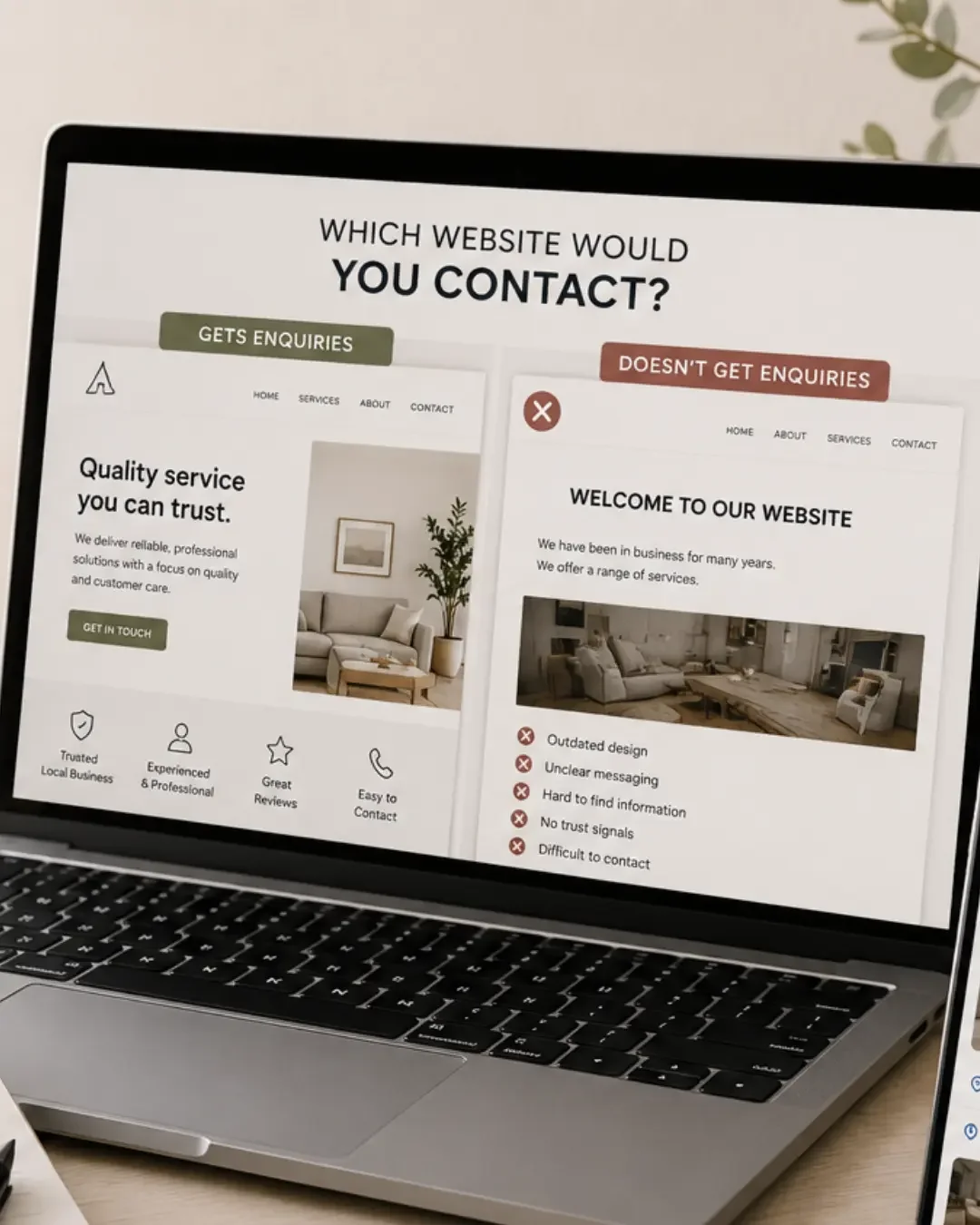
Why some business websites get enquiries (and others don't)
Two businesses can offer the same service.
Charge similar prices.
Have years of experience.
Even work in the same suburb.
Yet one receives regular enquiries through its website while the other hears almost nothing.
So what's the difference? It usually isn't luck. And it usually isn't because one business spends more on advertising. More often than not, it's because one website gives people confidence to take the next step. Your website isn't just there to provide information. Its job is to help someone decide whether they feel comfortable contacting you.
Here are some of the biggest differences between websites that generate enquiries and those that don't.
1. They build trust quickly
People don't spend ten minutes analysing your website. Most make an impression within a few seconds.
They're asking themselves:
Can I trust this business?
Do they look professional?
Do they seem established?
Would I feel confident contacting them?
Good websites answer those questions almost immediately.
2. They clearly explain what the business does
One of the biggest mistakes businesses make is assuming visitors already understand their services.
People shouldn't have to search your website to work out:
what you do
who you help
where you work
how to contact you
The easier it is to understand your business, the easier it is to make a decision.
3. They make it easy to take the next step
Some websites unintentionally make enquiries difficult.
Phone numbers are hidden.
Contact buttons are hard to find.
Forms ask for too much information.
Every extra step gives people another reason to leave. Websites that generate enquiries remove as much friction as possible.
4. They look current
An outdated website creates doubt. Even if your business is thriving, old photos, outdated information or an older design can make people question whether your business is still active. Your website doesn't need to be flashy. It simply needs to look current, professional and well maintained.
5. They support what customers have already seen
Most people don't visit your website first.
They often:
find you on Google
read your reviews
browse your Facebook page
look at your recent work
before clicking through to your website. If your website tells a different story from the rest of your online setup, confidence starts to disappear. Consistency matters.
6. They answer questions before they're asked
Great websites reduce uncertainty. Instead of making visitors contact you for basic information, they answer common questions upfront.
Things like:
service areas
pricing (where appropriate)
timeframes
process
frequently asked questions
The more confident people feel, the more likely they are to enquire.
7. They focus on the customer
Many websites spend too much time talking about themselves. Potential customers are usually thinking:
"Can you help me?"
Not:
"When was the business established?"
Not:
"What awards have they won?"
Those things can still be valuable, but they should support the message - not become the message. The best websites explain how the business solves problems and makes life easier for the customer.
Your website should be helping you win work
A website shouldn't simply exist because every business is expected to have one. It should actively support your business.
It should:
build trust
answer questions
make it easy to enquire
create confidence
support your Google Business Profile
reinforce the quality of your business
If it isn't doing those things, it's worth asking why. Sometimes the issue isn't your marketing. Sometimes it's the website itself.
Not sure whether your website is helping or hurting your business?
Sometimes it’s difficult to look at your own website objectively. When you see it every day, it’s easy to overlook what has become outdated, unclear or inconsistent.
If you know something is not quite right but you are not sure whether the issue is messaging, structure, trust, usability or the website itself, a Website Audit can help identify what is worth fixing first.
If the problem appears broader than the website - for example your website, Google Business Profile, reviews or other parts of your online setup are not working together - a Free Online Setup Review can help identify where I would start.
Because as your business evolves, your website should evolve with it.
Continue Reading
If you found this helpful, you may also like:
Website Design vs Website Redesign: Which One Do You Actually Need?
7 Signs Your Website Is Costing You Enquiries
What Customers Actually Look For Before They Contact Your Business
Explore Website Design →
Request a Website Audit →
Request a Free Online Setup Review→
Get in Touch→