A local service-business website doesn't need to be complicated. But it does need to do several jobs properly.
It needs to explain what the business does.
It needs to tell customers where the business works.
It needs to build enough trust for someone to make contact.
And it needs to give Google clear information about the services and locations the business wants to be found for. That is why I don't begin a website project by choosing colours or dropping content into a template. I start with the business.
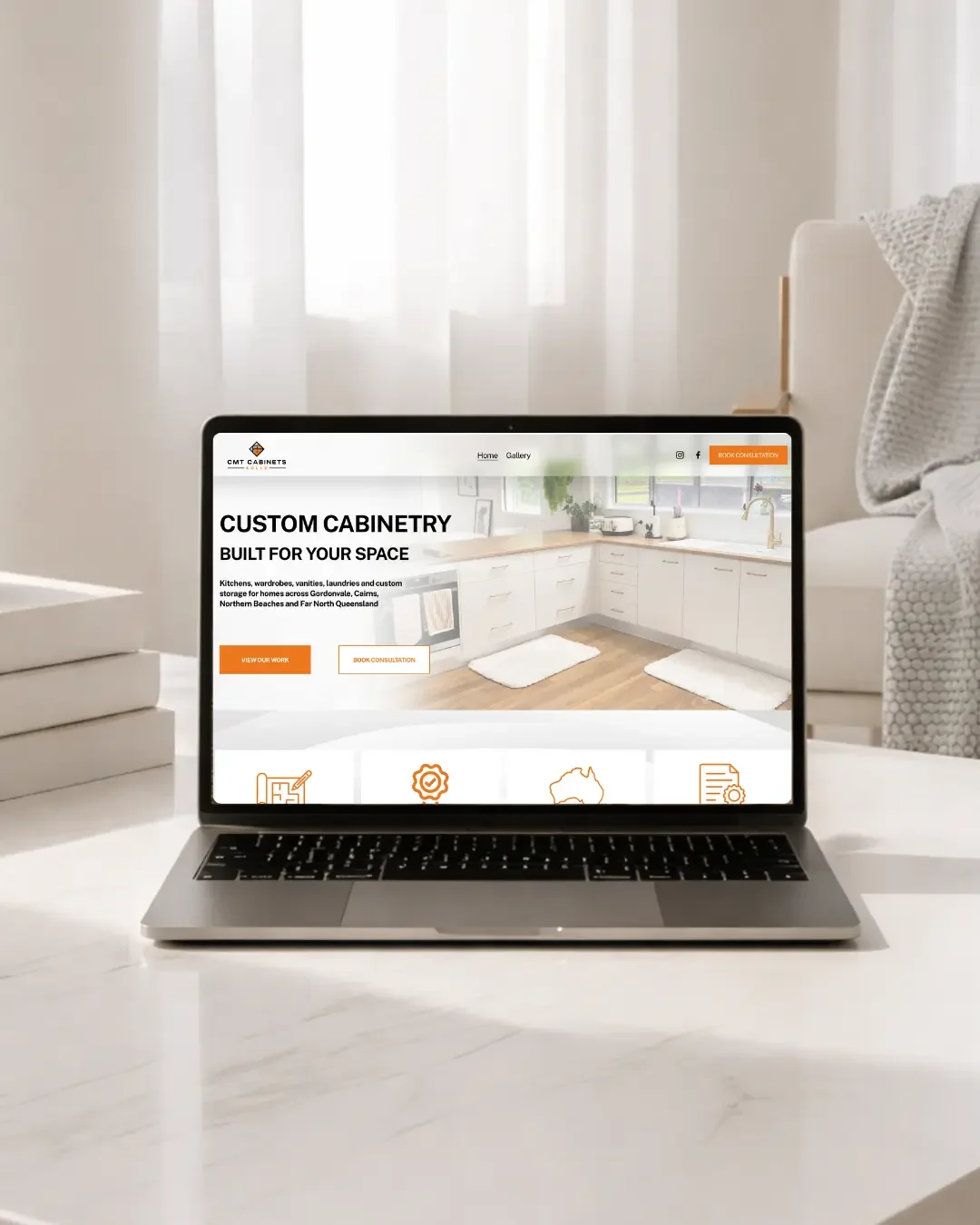
Using a recent North Queensland website project for CMT Cabinets as an example, here's how NQ Social Collective approaches building a local service-business website from the ground up.
The business
CMT Cabinets is a cabinetry business based in Gordonvale, servicing Cairns and surrounding areas.
The business provides custom cabinetry including:
kitchens
laundries
bathroom vanities
wardrobes
storage
entertainment units
office cabinetry
selected commercial work
Like many local service businesses, the website didn't need to be enormous.
It needed to clearly communicate:
what CMT does, where it operates, the quality of its work and how a potential customer can take the next step.
That sounds simple. But getting those foundations right is what makes the difference between a website that merely exists and one that actually supports the business.
Step 1: Start with what the customer needs to understand
Before thinking about design, I look at the questions a new customer is likely to have.
For CMT Cabinets, those questions might include:
What type of cabinetry do they do?
Do they work in Cairns?
Do they do full kitchens or smaller cabinetry jobs?
Is the work custom?
Can I see previous projects?
How do I get a quote?
Those questions help determine the structure of the website. A business owner already understands everything their company does. A new customer doesn't. The website therefore has to close that knowledge gap quickly.
Step 2: Make the main service obvious immediately
One of the biggest problems with small-business websites is vague messaging.
A homepage might open with something like:
Quality. Service. Experience.
That could describe almost any business.
Instead, the first section of the website should make it immediately clear what the business actually does.
For a local service business, I generally want the customer to understand within seconds:
the main service
the location
the type of customer or project
what to do next
That clarity helps people. It also gives search engines stronger information about the business.
For CMT Cabinets, the website needed to clearly position the business around custom cabinetry in Gordonvale, Cairns and surrounding areas rather than relying purely on visual design to communicate the service.
Step 3: Build the website around real services
The next question is:
What are people actually coming to this business for?
Those services should be easy to find.
For CMT, that meant clearly presenting work such as:
custom kitchens
laundries
bathroom vanities
wardrobes
storage
entertainment cabinetry
office cabinetry
selected commercial cabinetry
The purpose isn't to stuff the website with keywords. It's to make sure both customers and Google can understand the different services the business genuinely provides. This becomes particularly important when a business offers several commercially valuable services.
If an important service is buried in one sentence halfway down the homepage, it has very little opportunity to stand on its own.
Step 4: Use location naturally
For a local service business, location matters. A customer searching for cabinetry in Cairns needs to know whether the business actually works in their area.
Google needs that information too. That doesn't mean putting Cairns into every heading and paragraph.
It means naturally reinforcing the geographic relationship through:
homepage copy
service-area information
contact details
project descriptions
page titles
image information
supporting content
For CMT Cabinets, the location story is clear:
|The business is based in Gordonvale and services Cairns and surrounding areas.
That is much more useful than simply saying “we service Far North Queensland” without giving customers a clear idea of the core area.
Step 5: Show the actual work
Local service businesses have an advantage that many other businesses don't. They can show what they do. For cabinetry, building, roofing, landscaping, construction and many other trades, genuine project photos can be some of the most persuasive content on the website.
They show:
workmanship
project variety
style
experience
attention to detail
That's why I prefer using genuine client imagery wherever possible rather than filling a website with generic stock photography. A potential customer doesn't just want to read that the work is good. They want to see it.
The same principle applies to many other service businesses. A website should use the strongest evidence the business already has.
Step 6: Build trust before asking for the enquiry
A website shouldn't immediately demand “CALL NOW”.
People usually need some reassurance first.
For a local service business, trust can come from things such as:
project photos
genuine business information
clear service descriptions
customer reviews
experience
local service areas
professional branding
consistent contact information
Everything should work together. If the website looks professional but the business information is vague, trust drops. If the Google Business Profile says one thing and the website says another, trust can drop again.
Customers notice inconsistency even if they can't always explain exactly what feels wrong.
Step 7: Keep the design clean enough for the work to stand out
A website doesn't need to demonstrate how many animations, effects or design trends can fit on one page. For service businesses, the design should support the content. It shouldn't compete with it.
For CMT Cabinets, the cabinetry and completed projects needed to remain the visual focus.
That means using:
clean page structure
strong photography
straightforward navigation
readable text
clear headings
obvious contact options
The website should feel professional without becoming difficult to use.
Step 8: Think about mobile from the beginning
A significant number of potential customers will first see a local business website on their phone.
They may have found it through:
Google Search
Google Maps
Facebook
Instagram
a recommendation
a link somebody sent them
That means the mobile website isn't a secondary version. It matters just as much as desktop.
On mobile, I want to make sure:
headings aren't overwhelming
buttons are easy to use
images load and display properly
contact information is obvious
pages aren't unnecessarily long or cluttered
important information doesn't disappear
A beautiful desktop website that becomes frustrating on a phone is only half finished.
Step 9: Put the SEO foundations in place before launch
SEO shouldn't be something added as an afterthought once the website is finished. The basic search foundations should be considered during the build.
That includes:
page titles
SEO descriptions
heading structure
service wording
location relevance
page URLs
image file names
alt text
internal links
Google Search Console
sitemap submission
For local businesses, I also want the website to align with the Google Business Profile. The two should reinforce the same business. A website can look excellent, but if Google is receiving unclear information about what the business does or where it operates, visibility becomes harder.
Step 10: Make the next step obvious
The final question is:
What do we want the visitor to do?
For most local service businesses, that isn't complicated.
It may be:
request a quote
make an enquiry
call
email
complete a contact form
The important thing is that customers shouldn't have to hunt for it. Calls to action need to appear naturally throughout the site rather than being hidden on the final contact page.
Why I don't start with the website template
Squarespace gives me the platform I use to build many NQSC client websites. But Squarespace isn't the strategy.
The same template could be used for two businesses and produce completely different results depending on:
the structure
messaging
content
services
SEO
photography
calls to action
That is why choosing a website platform is only one part of the process. The more important question is:
What does this particular business need its website to achieve?
For CMT Cabinets, the answer wasn't “have a website”. It was to create a stronger online representation of the business and its work while making it easier for customers around Cairns and Gordonvale to understand the services and make contact.
What makes a good local service-business website?
Looking across this project and the other service-business websites I build, the fundamentals are remarkably consistent.
A good local business website should tell a visitor:
What do you do? Don't make them work it out.
Where do you work? Make your actual service area clear.
Why should they trust you? Use genuine evidence rather than vague claims.
Can they see what you do? Where possible, show projects, results or examples.
What should they do next? Make the enquiry pathway simple.
Does Google understand the same business?
Your website, Google Business Profile and wider online presence should reinforce one another. If those foundations are working, the website is doing much more than simply making the business look professional.
Do small businesses need large websites?
No. A bigger website isn't automatically a better website. Some businesses only need a small number of well-planned pages. Others need individual service pages because they offer several important services or compete across different search terms.
The structure should be based on the business rather than an arbitrary package. That's why I don't believe every small business automatically needs a five-page, ten-page or twenty-page website. It needs enough content to properly represent the business and support what the customer is trying to do.
Frequently Asked Questions
What should a local service-business website include?
At minimum, customers should be able to understand what the business does, where it operates, why it is credible and how to contact it. Depending on the business, that may include service pages, project galleries, reviews, FAQs, service areas and supporting blog content.
How many pages does a small business website need?
There is no fixed number. A simple business may only need a small number of carefully structured pages. A business offering several important services may benefit from separate pages for those services. The website structure should reflect customer needs and search behaviour.
Should every service have its own page?
Not necessarily. A service may deserve its own page when it is commercially important, different enough from other services or something potential customers actively search for. Minor or closely related services can often be grouped together.
Is Squarespace suitable for a local service business?
For many local and service-based businesses, yes. Squarespace can provide a professional, manageable website without creating an unnecessarily complicated system behind it. The quality of the strategy and build remains more important than the platform alone.
How long will a new website take to rank on Google?
There is no fixed timeframe. Google may discover and index a website relatively quickly, but competitive rankings usually take longer. Website structure, content, competition, local signals and existing authority all influence the process.
Your website should represent the business you've actually built
A local business can spend years improving its workmanship, reputation, team and service. But sometimes the website is still representing the version of the business that existed years ago.
A website redesign or new build gives you the opportunity to bring those pieces back together. Not by making the website complicated. By making it clearer.
What do you do?
Where do you work?
Why should someone trust you?
What should they do next?
When those answers are clear, the website starts doing its real job.
Need a website for your Townsville or North Queensland business?
NQ Social Collective designs and redesigns websites for small and service-based businesses across Townsville and North Queensland. I look at more than the appearance of the website.
The build considers:
website structure
services
customer journey
local SEO foundations
Google Business Profile alignment
trust
conversion
how the wider online setup fits together
The goal isn't simply to put a website online. It's to build an online asset that properly represents the business and makes it easier for the right customers to find, understand and contact you.
You can also view recent NQSC projects in the Portfolio.
Continue Reading
If this article was helpful, you may also like to read more about:
Do You Need a Website if You Already Have a Google Business Profile?
Squarespace Website Design: Is It Right for Your Small Business?
Website Design vs Website Redesign: Which One Do You Actually Need?
Request an Online Setup Review→
View all services→
Get in Touch→